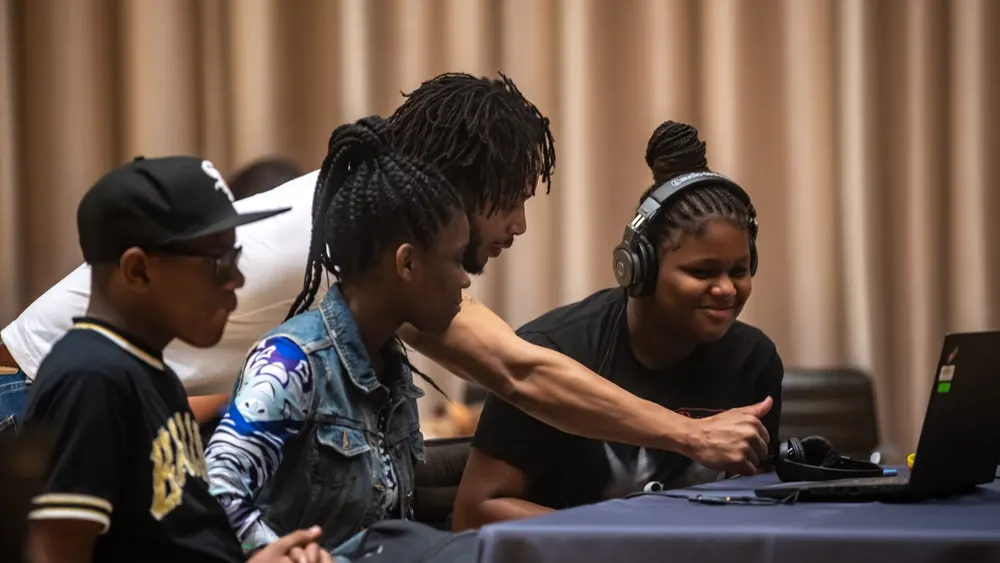
People hear music education and think about songs, instruments, performances, and production software.
Those things matter. But they are not the whole story.
Music is one of the most complete thinking environments a student can enter. It asks the mind to recognize patterns, manage time, hold information, make decisions, respond to feedback, regulate emotion, and work with other people.
That is why we call music the ultimate thinking gym.
The beat is the entry point. The real training happens underneath it.
Music Trains Perception
Before a student can change a sound, they have to hear it.
That sounds simple until you watch a young producer learn to separate the kick from the bass, identify where a melody feels crowded, or recognize that the problem is not volume but space.
This is situational awareness in sound.
Students learn to notice small signals, compare details, and decide what deserves attention. Their ears become more precise because they are no longer hearing one wall of noise. They are hearing relationships.
That skill transfers. Better observers ask better questions because they notice what other people miss.
Music Makes Patterns Visible
Rhythm is pattern. Melody is pattern. Song structure is pattern across time.
Students hear repetition, variation, expectation, and surprise. They learn that a pattern can create stability, while a broken pattern can create energy or tension.
Pattern recognition is one of the engines of learning. It helps people connect new information to something they already understand. It also fuels prediction. Once a student recognizes how a verse, chorus, or transition works, they can anticipate what may come next and decide whether to follow the expectation or flip it.
Music does not only teach students to recognize patterns. It teaches them to use patterns with intention.
Every Track Is a System
A song is not a pile of separate sounds. It is a system.
The drums affect the bass. The bass changes how the melody feels. The vocal competes for space with every other element. Adjust one piece and the rest of the track may need to move.
That is systems thinking.
Students learn that improving one element in isolation does not always improve the whole. A bigger kick can sound exciting by itself and ruin the mix. A beautiful melody can still be wrong for the song.
The lesson is clear: local improvement is not the same as system improvement.
That idea matters in engineering, business, technology, relationships, and leadership.
Music Builds Temporal Awareness
Music only works through time.
Students learn sequence, pacing, anticipation, memory, and consequence. A sound placed one second too early can change the entire emotional effect. Silence can create tension. A transition can prepare the listener for what is coming next.
Temporal awareness teaches students to ask: What happened before this? What needs to happen now? What will this decision create later?
That is strategic thinking in musical form.
The Studio Trains Attention
Creative focus is not passive. It is sustained attention with a purpose.
Inside a studio session, students listen closely, hold ideas in memory, compare versions, and make repeated adjustments. They move between the details and the full track without losing the goal.
Research has linked music training with attention, working memory, and other executive functions, but we should be careful about promising that music automatically makes every student smarter. The evidence is still developing, and outcomes depend on the type, quality, and duration of the experience.
What we can say with confidence is that music gives students a meaningful reason to practice attention.
They want the track to work, so they stay with the problem.
Feedback Becomes Part of the Craft
Music teaches students that the first version is rarely the final version.
They listen, revise, compare, and try again. They learn that feedback is not an attack on identity. It is information that can improve the work.
This builds adaptability. Students begin to understand that failure is not the opposite of progress. It is often part of the process.
A rough mix is not proof that they cannot create. It is a signal that the work is not finished.
Music Connects Thought and Emotion
Some forms of learning act as if logic and emotion live in separate rooms. Music shows students they are connected.
A producer makes technical decisions to create an emotional result. Tempo, texture, harmony, dynamics, and silence all influence how the listener experiences the track.
Students practice emotional awareness while making structured decisions. They learn that feeling deeply and thinking clearly are not opposites.
That ability to hold both is part of mature judgment.
The Vehicle and the Destination
We teach production, arrangement, recording, engineering, and performance. Those are real skills with real career value.
But the deeper outcome is a student who can perceive, connect, decide, create, adapt, and lead.
Music is the vehicle. Human development is the destination.
Every session becomes a place to train the ear, the mind, the emotions, and the discipline to finish what you started.
That is bigger than a song.
That is a thinking gym.
Research: NCCIH: Music and Health, What You Need To Know | Music Training, Working Memory, and Neural Oscillations: A Review