Every app wants it. Every platform studies it. Every notification is designed to interrupt it.
Attention is becoming one of the world’s most valuable resources because nearly everything meaningful depends on it.
Learning requires attention. Creativity requires attention. Relationships, judgment, safety, leadership, and self-awareness all require the ability to stay present long enough to notice what matters.
The problem is not that young people lack focus. The problem is that they are growing up inside systems competing to capture it.
That changes what education must teach.
Attention Is More Than Concentration
Focus is often described as sitting still and completing a task. That is too narrow.
Attention is the ability to direct mental energy with intention. It includes choosing what to notice, what to ignore, when to stay with a problem, and when to shift.
That makes attention part of situational awareness. A student cannot recognize an important signal if every signal feels equally urgent.
Attention also supports judgment. If you only see the loudest piece of a situation, you may miss the most important one.
Distraction Has a Cost
Notifications do not have to be opened to interrupt performance. Research has found that push notifications can affect attention-demanding tasks, while studies of media multitasking have reported associations with distractibility and weaker performance in some cognitive areas.
The evidence is not simple enough to say phones are destroying every student’s brain. Technology can support learning, connection, and creativity.
The real issue is control.
Who decides where the student’s attention goes: the student, the teacher, the goal, or the algorithm?
When attention is constantly redirected from the outside, independent thought becomes harder to sustain.
Own Your Attention
Owning your attention does not mean rejecting technology. It means using technology without letting it decide your priorities.
Students need practical ways to protect focus:
- Turn off nonessential notifications during important work.
- Create clear beginnings and endings for focused sessions.
- Put the phone out of reach when the task requires depth.
- Work on one meaningful objective at a time.
- Take intentional breaks instead of drifting into endless scrolling.
- Notice what kinds of environments help or hurt concentration.
These are not punishment rules. They are methods for preserving mental agency.
The Studio Becomes Attention Training
A strong studio session gives attention somewhere meaningful to go.
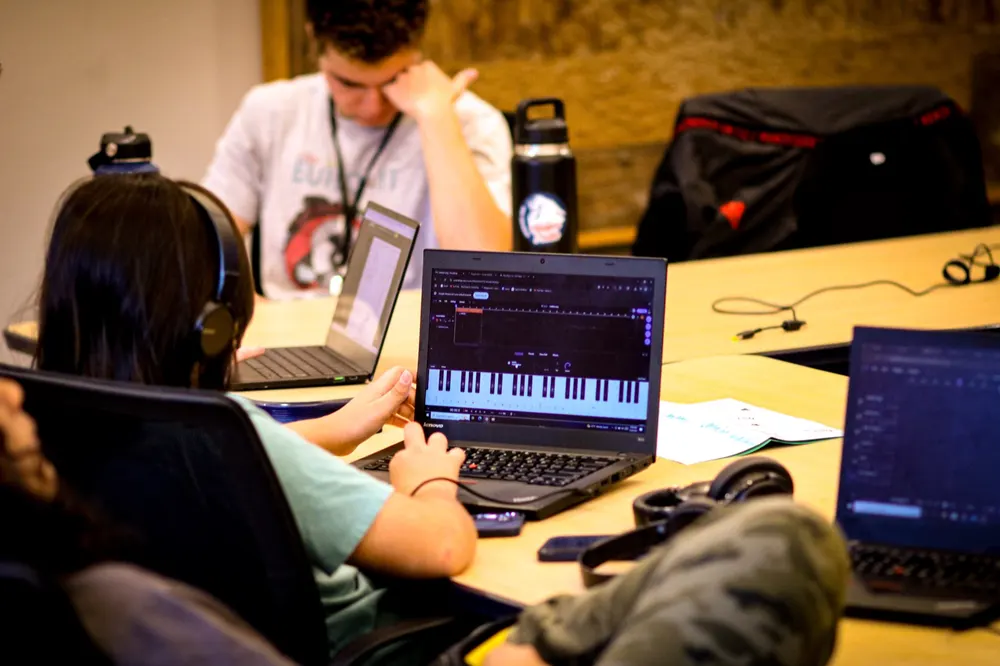
Students listen for details, hold a musical idea in memory, compare versions, and make small adjustments. They move between the full track and one specific sound. They stay with a problem because they care about the result.
That is different from demanding focus without creating relevance.
Creative work turns attention into a visible outcome. The student hears the difference between a rushed decision and a careful one. They experience the reward of staying with an idea long enough for it to improve.
Focus becomes part of the craft.
Deep Work Requires a Reason
People do not protect attention because a poster tells them to focus. They protect it when the work feels connected to identity, curiosity, purpose, or ownership.
That is why student agency matters.
A learner who has a meaningful choice in the work is more likely to invest attention. A student building something real has a reason to return after frustration.
This does not mean every task must be entertaining. It means students should understand what they are building, why it matters, and how their effort changes the result.
Purpose gives focus a direction.
Attention Shapes Identity
What we repeatedly pay attention to changes what we notice, remember, practice, and become good at.
Attention is not only about productivity. It shapes identity.
If a student gives hours to comparison, outrage, and interruption, those patterns become familiar. If they give sustained attention to craft, relationships, learning, and service, those patterns grow too.
This is why Own Your Attention connects to Own Your Mind. A person who cannot protect focus will struggle to protect independent thought.
Balance Matters
Focus is not endless intensity. Human beings need rest, play, movement, conversation, and recovery.
The goal is not to squeeze productivity out of every minute. The goal is to become deliberate.
Know when to lock in. Know when to pause. Know when the mind is tired and when it is avoiding discomfort.
That is temporal awareness applied to energy.
The New Literacy
Students are taught to read words, numbers, and media. They should also learn to read their own attention.
What captures it? What drains it? What strengthens it? What deserves more of it?
In a world built to interrupt, focus becomes a form of freedom.
The person who can direct attention can learn deeply, create original work, notice important signals, and make decisions without being pulled by every new stimulus.
Attention is currency.
Students should learn how to spend it on purpose.
Research: Effects of Smartphone Push Notifications on Task Performance | Sustained Attention and Media Multitasking Among Adolescents